





Abstract
Background
Long-term materials evolution contains many local updates between structurally decisive states. In Cu-rich reactor pressure vessel (RPV) steel, vacancy-mediated atomic exchanges drive the formation of Cu-rich precipitates. The events carrying persistent structural progress appear sparsely and at different positions across microscopic trajectories.
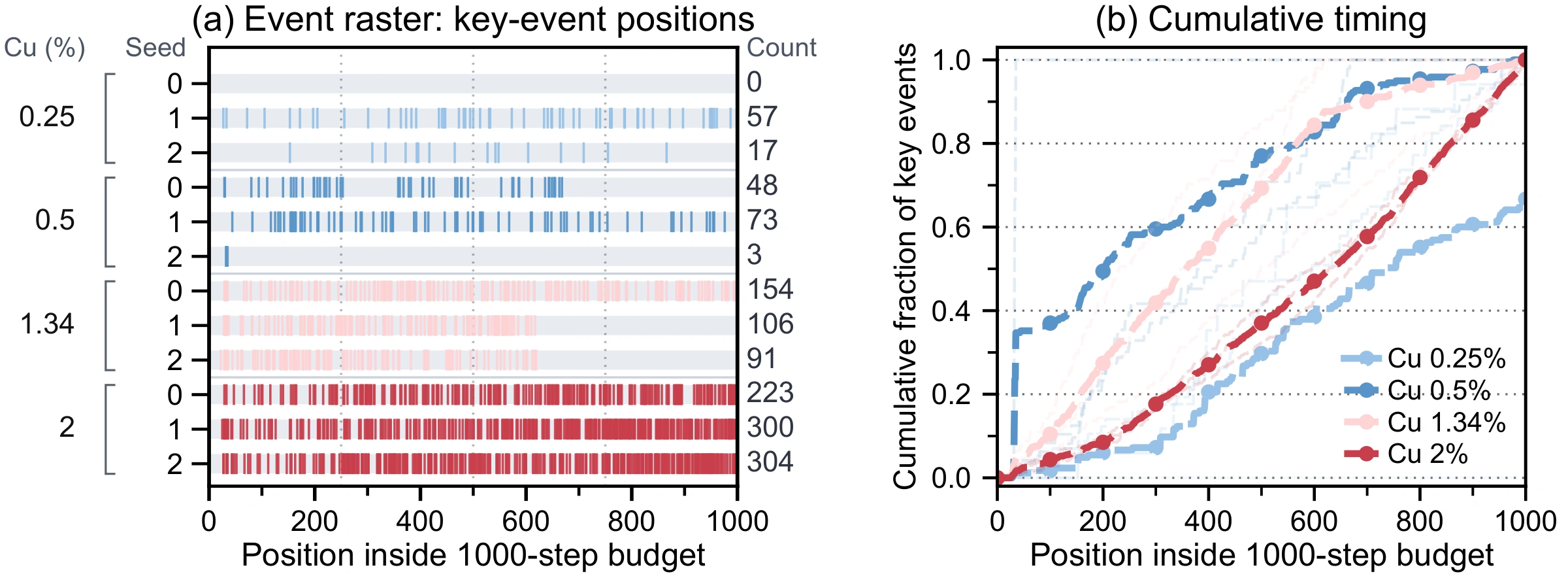
Figure 1: Cu-vacancy exchange events within a fixed 1,000-micro-event replay budget. Each row corresponds to a Cu concentration and random seed; the cumulative curves show how key events accumulate over the budget.
Highlights
-
🧭 Critical evolution backbone. Learn sparse state transitions that carry persistent structural progress through long atomistic trajectories.
-
⚛️ Physically constrained edits. Predict changes on local candidate sites and project atom-vacancy transport to preserve material inventory.
-
⏱️ State and time together. Condition accumulated duration on a learned path representation, so every structural advance carries a physical clock update.
-
🔁 Closed-loop world modeling. Re-encode the projected prediction as the next input, using the same constrained forward path during training and rollout.
-
📏 Multi-K macro steps. Condition predictions on the requested horizon in
K={1 to 1024}to learn transitions at multiple evolutionary resolutions. -
🚀 Accelerated materials evolution. Mirror achieves 10³–10⁴× speedups across five atomic systems.
Objective
AtomWorld-Mirror learns the critical evolution backbone: a sequence of physically reachable states that captures persistent structural progress. Each macro transition predicts a sparse structural edit, the next latent state, and the accumulated physical duration. Repeated macro steps advance the material configuration and its physical clock together.
Method
From microscopic trajectories to macro transitions
AtomWorld provides the simulator-exposed configurations, local event support, and physical clock. Mirror learns the corresponding macro-step dynamics. Training segments pair a starting configuration with an endpoint, sparse edit targets, a path summary, and accumulated duration.
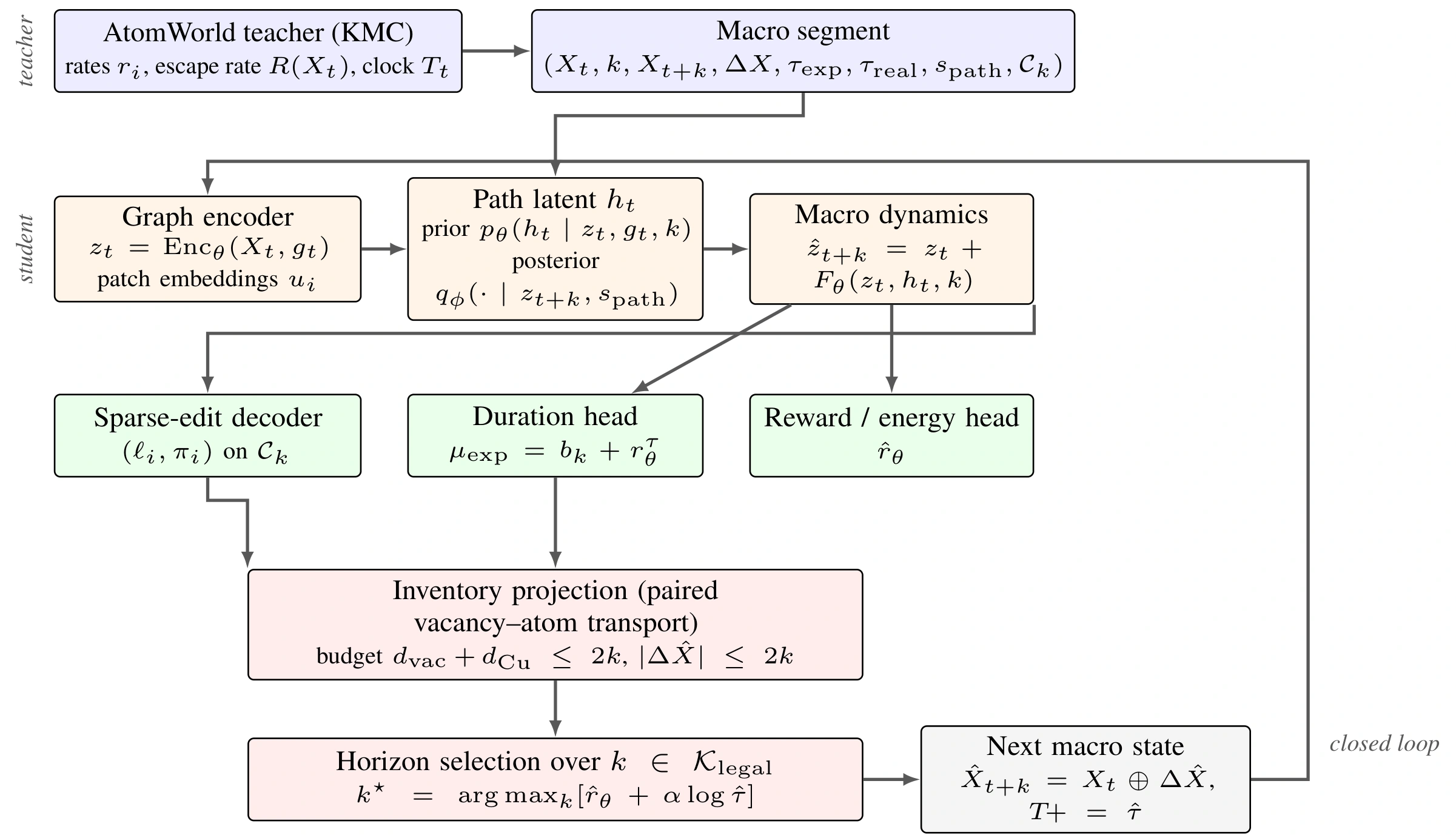
Figure 2: AtomWorld-Mirror architecture. Graph and patch representations feed horizon-conditioned latent dynamics. Sparse edits pass through inventory projection, and the resulting state is reused at the next macro step. Reproduced from Figure 5 of the paper.
A macro step follows four stages:
- Encode the current configuration. A graph encoder and an active-patch encoder summarize the atomic environment and candidate sites.
- Infer a path representation. A horizon-conditioned latent captures the microscopic evolution compressed into the macro transition. Training uses a path posterior and learns a matching prior; rollout samples the prior from current-state information.
- Predict and project. Macro dynamics produce a future latent, sparse site edits, and duration/energy predictions. Projection enforces inventory-preserving edits within the local support and transport budget.
- Advance structure and time. Apply the projected edit, add the predicted duration to the physical clock, and encode the new state for the next transition.
Structural and Temporal Accuracy
Controlled validation against the KMC teacher measures sparse structural changes and expected physical time. Paired segments test endpoint prediction and single-segment duration, while long trajectories measure cumulative changes, cumulative time, and structural fidelity.
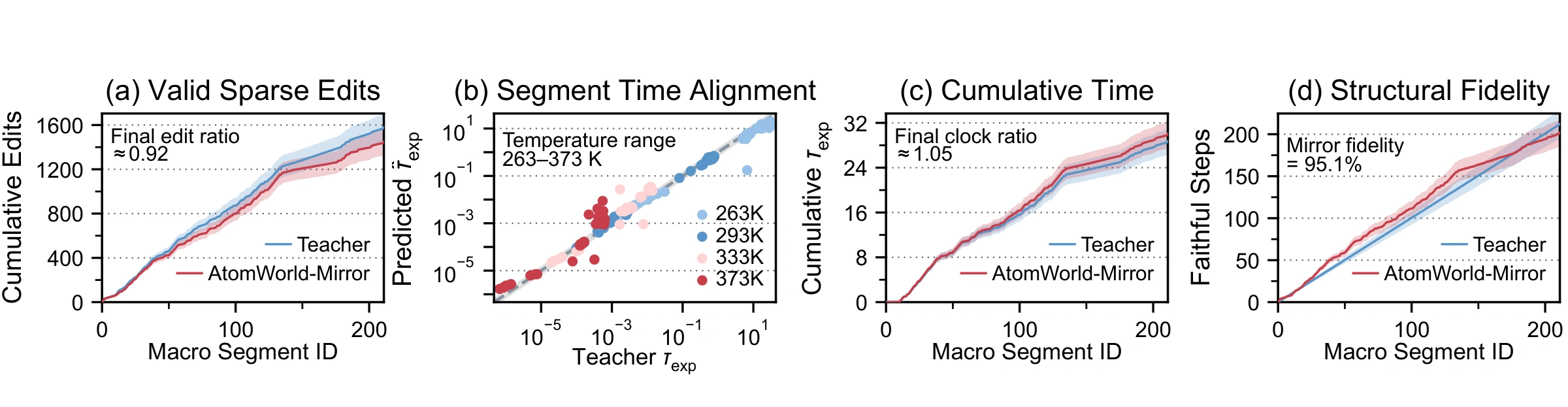
Figure 3: Structural edits, single-segment expected-time alignment across temperatures, cumulative expected time, and structurally faithful steps over 200 macro segments. Reproduced from Figure 2 of the paper.
Physical Constraints
Autonomous model rollouts apply each projected edit to the previous model state. Local KMC probes evaluate the resulting transitions. Ablations measure energy error, reachability violations, inventory violations, time error, and edit error across two Cu concentrations and four temperatures.
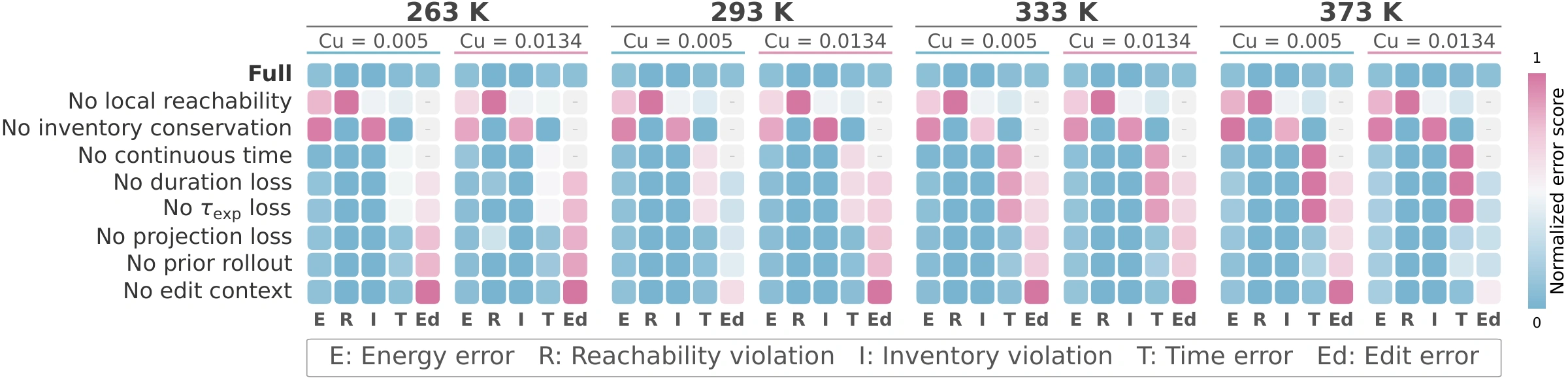
Figure 4: Multi-K teacher-probe ablations. Each physical component has a distinct role in maintaining valid state-time transitions. Reproduced from Figure 3 of the paper.
Inference Efficiency
A macro step replaces explicit replay of intervening microscopic events with inference on a local candidate patch. The paper reports speedups of 103 to 104 across its material-system timing diagnostics. The benchmark below compares teacher replay, rate-scaling KMC, superbasin KMC, and AtomWorld-Mirror over lattice sizes and temperatures. Timing includes benchmark orchestration and batched neural inference.
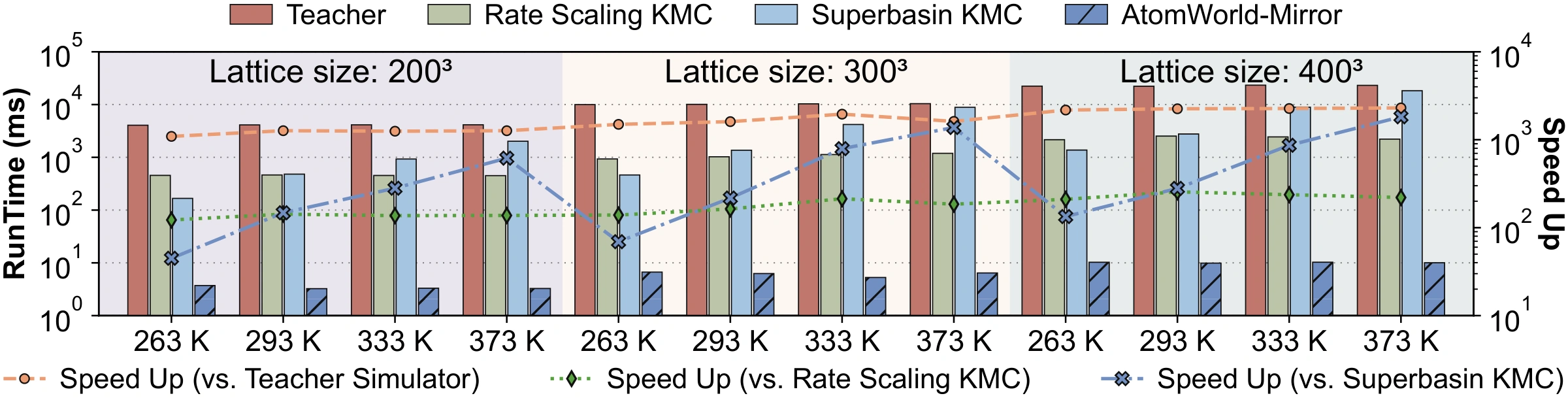
Figure 5: End-to-end timing diagnostic across lattice sizes and temperatures. See Figure 4 and Appendix D of the paper for benchmark settings and per-system measurements.
Citation
@misc{pan2026atomworldmirror,
  title={AtomWorld-Mirror: Macro-Step World Modeling of
         Critical Evolution Backbones for Materials Dynamics},
  author={Pan, Ziming and Zhang, Ruge and Han, Haozhi and
          Chen, Yifeng and Zhang, Yunquan and Cao, Ting and
          Liu, Yunxin and Li, Kun},
  year={2026},
  howpublished={Project manuscript},
  url={https://github.com/RecursiveScienceAIR/AtomWorld-Mirror}
}